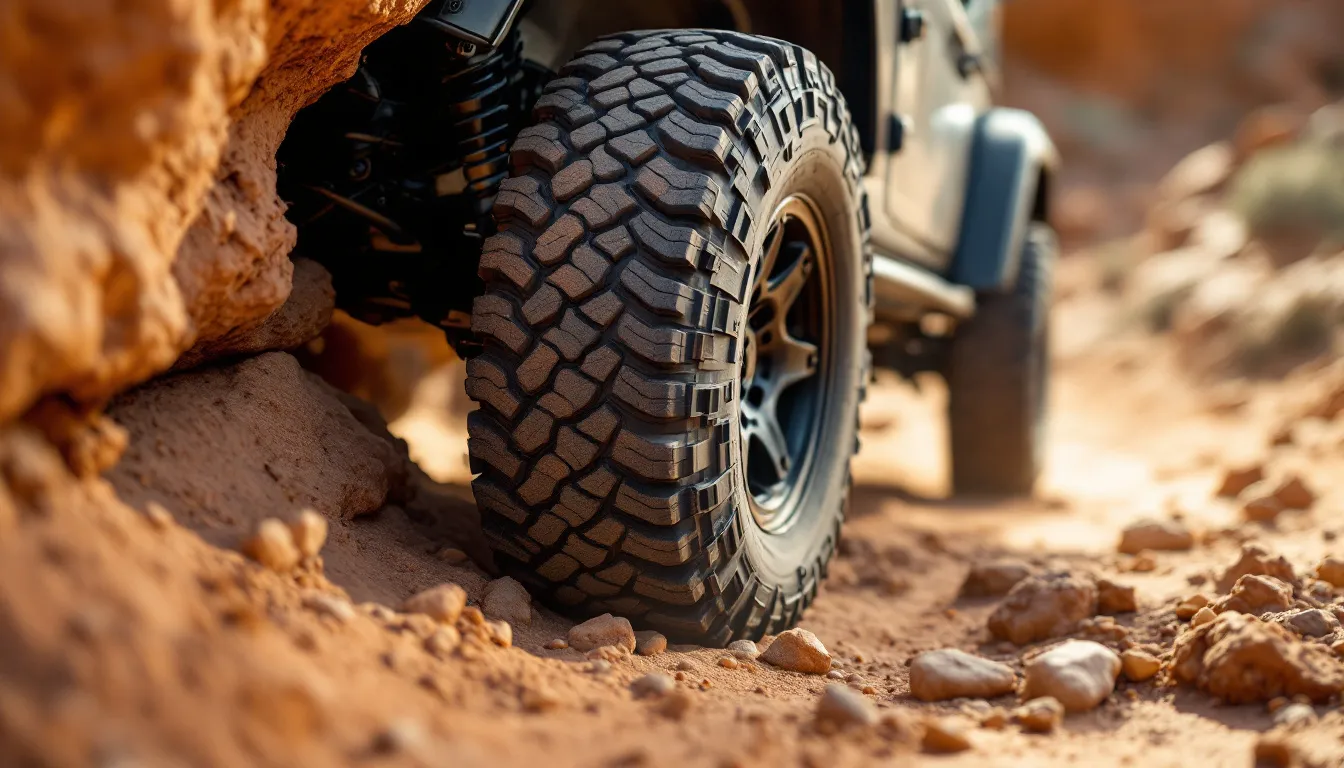
An all-terrain rock crawling tire has to handle two jobs at once: grip on rocks at 5 mph with the engine near stall, then survive the highway back home at 65 mph without destroying your eardrums. That balance requires reinforced sidewalls, a softer compound that conforms to rough surfaces, and aggressive lug spacing that lets the tire self-clean on loose terrain without clogging.
The three strongest choices for JL Wrangler rock crawling are the BFGoodrich All-Terrain T/A KO2, the Falken Wildpeak AT3W, and the Goodyear Wrangler DuraTrac. All three are available in JL-appropriate sizes, come in load ranges that handle serious rock work, and come up repeatedly in owner discussions on forums like WranglerForum.com and JeepGarage.org as tires that actually deliver on technical terrain rather than just marketing copy.
If you have 30 seconds: grab the BFG KO2 if you want the tire proven on rock for over 15 years, the Falken if budget matters and you don't want to sacrifice sidewall strength, and the DuraTrac if you're splitting trail time between rock and mud equally. The breakdown below covers sizing by trim, a spec-by-spec comparison, and the real-world details that shift the answer for your specific JL.
What Rock Crawling Actually Demands From a Tire
Rock crawling breaks tires in ways that highway driving and even routine dirt road work simply do not. You're moving at walking speed or slower, balancing the Jeep across sharp ledges and dropping it into boulder fields. The terrain is unforgiving, the contact patches are small, and the sidewall takes direct impacts that would shred a highway tire in minutes.
Rock crawling stacks three core demands on any tire that's going to survive the work:
Sidewall strength. The sidewall doesn't just flex here, it contacts rock edges directly. Most serious JL rock crawlers will not run anything below a D-load tire (8-ply rated), and many prefer E-load (10-ply rated) specifically for the thicker sidewall construction. C-load tires work for light trail use, but owners consistently report more pinch flats and sidewall tears when the terrain gets genuinely rocky. If you're shopping for a tire and you see "off-road" in the name but it's only C-load, keep shopping.
Compound softness. Softer compounds deform around the microscopic texture of rock and generate grip without needing vehicle momentum to work. Most all-terrain tires use a silica-enhanced compound that stays flexible in cold and shade, which matters when you're crawling across north-facing slickrock in the morning. A hard, highway-focused compound will slip on wet rock where a softer AT tire bites.
Lug geometry. Widely spaced, staggered lugs bite into irregular surfaces and shed loose material without packing mud or decomposed granite into the tread. Dense, highway-style lugs don't work here because they don't have room to self-clean. You need void space that lets the tire shed, and lug spacing wide enough that on a flat slab the compound itself can squish and contact the surface.
You also need to match the load index to your specific JL trim. A 4xe weighs more than a base Sport, so it requires a higher load index for the same tire size. Grab the wrong one and you've got a warranty liability and a safety problem. More on that in sizing.
All-Terrain vs Mud-Terrain: Which One Wins on Rock
For most JL owners who actually drive on pavement between trail days, all-terrain tires are the stronger choice on rock. Mud-terrain tires offer slightly more aggressive sidewall lugs and maximum bite in mud, but modern AT tires like the KO2 and AT3W match or exceed them on dry rock while being dramatically quieter on the highway.
| Attribute | All-Terrain | Mud-Terrain |
|---|---|---|
| Highway noise | Moderate | Loud (humming above 60 mph) |
| Tread life | 50,000–60,000 miles typical | 30,000–40,000 miles typical |
| Dry rock grip | Excellent | Very good |
| Wet rock grip | Very good | Good |
| Sidewall puncture resistance | Good (D/E-load) | Very good (E-load standard) |
| Price per tire (285/70R17 approx) | $200–$280 | $250–$320 |
| Best fit for | Daily driver + weekend trail | Dedicated wheeler, minimal road miles |
The value case for AT tires is pretty straightforward if your JL logs road miles. Mud-terrain tires cost more, wear out faster on pavement, and create enough highway noise that owners often describe them as tiring to drive. Without a real rock grip advantage over a quality AT tire, the trade-off doesn't make sense for most people.
The one nuance: sidewall construction. Many MT tires run stiffer E-load sidewalls as standard, whereas some AT tires ship in C or D-load range. If you're buying AT tires for serious rock, specifically target D or E load range. Don't assume the "off-road" label means the sidewall is built for rock contact.
For 4xe and eTorque JL owners, there's one more detail worth noting. The extra torque from those drivetrains can spin a softer MT tread on loose decomposed granite and scree, while an AT compound's controlled deformation tends to hook up more consistently. Owner forums on 4xe models report this difference repeatedly enough that it's worth considering if you're torn between the two.
Top All-Terrain Tires for JL Wrangler Rock Crawling
The three tires below represent the strongest consensus from JL owner forums, manufacturer specs, and off-road tire testing data. These are researched picks, not personal testing. Your budget, available sizes, and terrain mix will determine which is the right fit for your specific rig.
BFGoodrich All-Terrain T/A KO2
The KO2 is the default answer because it earned that spot over 15 years of rock crawling. BFG designed it with a 3-ply sidewall, serrated shoulder lugs for ledge grip, and CoreGard technology to resist splitting under sidewall stress. It shows up in nearly every serious JL owner's decision process.
Size range is extensive and JL-friendly: 255/75R17, 285/70R17, 265/70R17, and up to 37x12.50R17 for lifted builds. Load range runs from C through E depending on size. For rock work, you want E-load (10-ply rated) where available, or at least D-load. Owners consistently describe the KO2 as predictable on slickrock, where the compound deforms enough at aired-down pressures to generate real grip without the sponginess that causes folding under sidewall load.
You'll pay around $220 to $265 per tire in 285/70R17. The 50,000-mile treadwear warranty and 500 UTQG rating are competitive for a rock tire. The honest trade-off: it's not the cheapest option, and owners who run heavy mud report it packs tread faster than dedicated MT tires.
Falken Wildpeak AT3W
The AT3W earns its spot by matching the KO2's sidewall construction while running $30 to $50 cheaper per tire. Falken builds it with a 3-ply polyester sidewall, heat diffuser technology in the lower sidewall, and offset shoulder blocks designed to grab rock transitions and ledges.
Available JL sizes include 265/70R17, 285/70R17, and several 18-inch options if you're keeping stock wheels. Like the KO2, it comes in C through E load ranges, and you want the E-load version for technical rock. JL forum owners frequently cite the AT3W as the value leader in this tier, with rock performance that tracks the KO2 closely on granite and sandstone.
Expect to pay $185 to $240 per tire in 285/70R17. Tread life feedback is mixed relative to the KO2, with some owners reporting faster center wear on highway-heavy use. If your JL splits time roughly evenly between pavement and trail, that's a real consideration.
Goodyear Wrangler DuraTrac
The DuraTrac is the specialist pick for owners who mix rock crawling with heavy mud and loose sand. Its tread pattern sits closer to the mud-terrain end of the spectrum, with large widely spaced blocks and self-cleaning grooves. On dry rock it generates strong traction, and Goodyear's TractiveGroove technology expands under load to grip soft terrain transitions.
Size availability covers JL fitments well: 265/70R17, 285/70R17, 255/75R17, and others. The DuraTrac ships in C and E load ranges depending on size. Owner feedback on rock is solid, though the wider void ratio means slightly less tread contact on pure slickrock compared to the KO2. On mixed rocky and muddy trails, owners consistently say it outperforms both the KO2 and AT3W.
Price lands around $210 to $260 per tire in 285/70R17. The one honest downside: the DuraTrac is noisier on pavement than either of the other two, sitting closer to mud-terrain volume levels.
JL Wrangler Tire Sizing: What Actually Fits Without a Lift
Knowing what size fits your JL without rubbing is the first question. The answer depends on your trim and whether you have a lift. These figures come from Jeep's published specs and widely reported owner experience.
| Trim | Stock Size | Max Without Lift | Max With 2-inch Lift |
|---|---|---|---|
| Sport (2-door/4-door) | 255/70R18 | 33 inches / 285/70R17 | 35 inches / 315/70R17 |
| Sahara | 255/70R18 | 33 inches / 285/70R17 | 35 inches / 315/70R17 |
| Rubicon | 285/70R17 | 35 inches (fender trim needed) | 37 inches |
| 4xe | 255/70R18 | 33 inches / 285/70R17 | 35 inches (verify load index) |
The JL's independent front suspension geometry is a meaningful change if you're coming from a JK. The IFS has less uptravel clearance than a solid axle, so tire-to-fender contact on compression and droop happens at smaller sizes than JK owners sometimes expect. The 4-door JLU has slightly more room than the 2-door in practice, but the difference is smaller than internet lore usually claims.
4xe owners need one extra step. The 4xe's higher curb weight and GVWR means that when you upsize tires, the load index requirement increases. A 285/70R17 in C-load range may not meet the 4xe's specifications. Check the load index for your exact tire and size against the vehicle's GVWR before you buy. This isn't a warranty technicality. Running an undersized load index on a 4xe can cause tire failure under load, and owner reports on 4xe forums flag this as a commonly missed step that leads to warranty denials.
Key Specs to Compare Before You Commit
Before you finalize your choice, compare the specs that actually move the needle for rock work: ply rating, tread depth, and sidewall coverage. The table below locks in at 285/70R17 for direct comparison. Prices reflect 2026 market data.
| Spec | BFG KO2 | Falken Wildpeak AT3W | Goodyear DuraTrac |
|---|---|---|---|
| Ply rating | 3-ply sidewall (10PR max) | 3-ply sidewall (10PR max) | Up to 10PR (E-load) |
| Load range options | C, D, E | C, D, E | C, E |
| Tread depth (32nds) | ~15/32 | ~17/32 | ~16.5/32 |
| UTQG treadwear | 500 | 640 | 520 |
| Sidewall lug coverage | Full perimeter serrations | Offset shoulder blocks | Partial shoulder lugs |
| Price per tire (285/70R17) | $220–$265 | $185–$240 | $210–$260 |
| Tread warranty | 50,000 miles | 55,000 miles | 50,000 miles |
A few patterns stand out here for JL rock crawlers. The Falken AT3W comes with roughly 17/32nds of tread, noticeably deeper than the KO2's 15/32nds, which means more rubber before the tire hits wear-out. Its 640 UTQG rating is higher than the KO2's 500, which typically means slower wear on pavement but doesn't directly predict rock performance.
The KO2's serrated perimeter sidewall coverage is the most aggressive of the three for edge protection. If your rock crawling involves tight boulder gardens where sidewall contact is likely, that matters. The DuraTrac's partial shoulder lugs are effective in mud transitions but offer less dedicated armor on sharp ledges.
For D or E load range availability in your target size, confirm availability before ordering. Not all three tires come in every load range for every size.
Airing Down: The Step That Unlocks Rock Performance
Airing down is what transforms a capable AT tire into a genuinely effective rock crawler. Reducing pressure increases the contact patch, lets the tread conform to irregular surfaces, and allows the sidewall to absorb impacts. Most JL owners and tire manufacturers recommend 12 to 18 PSI for technical rock crawling, depending on tire size and vehicle weight.
The 4xe and heavier JL variants should stay toward the high end of that range (15 to 18 PSI) because extra vehicle weight increases the risk of the bead unseating at lower pressures.
Stay above 10 PSI on standard wheels. Below that, the tire can unseat from the rim when the sidewall flexes under a lateral load, and a sudden deflation on a rock face turns into a recovery situation you do not want. Beadlock wheels lock the bead mechanically and allow pressures as low as 4 to 6 PSI safely, but that's a separate purchase and install.
Rubicon owners have a built-in advantage: the factory air compressor lets you air back up at the trailhead without carrying portable gear. Non-Rubicon owners will want onboard or portable equipment for the return trip. Leaving rock pressures in for the highway ride home accelerates shoulder wear and kills your handling.
Frequently Asked Questions
Are 33s or 35s better for rock crawling on a JL Wrangler?
35-inch tires provide more sidewall height, which means more flex and a larger contact patch at low pressures. For dedicated rock crawling, most experienced JL owners prefer 35s, though they require at minimum a 2-inch lift on non-Rubicon trims to avoid consistent rubbing on flex.
Do I need a lift to run 35-inch AT tires on my JL?
On a Rubicon, 35s fit with minor fender liner trimming and no lift, though clearance on full droop is tight. On Sport and Sahara trims, a 2-inch lift is the practical minimum before running 35s without rubbing issues.
What ply rating should I target for rock crawling?
Target D-load (8-ply) at minimum, with E-load (10-ply) preferred for technical or sharp rocky terrain. The extra sidewall stiffness resists punctures and tearing when the tire contacts rock edges directly. C-load tires are undersized for serious rock work.
How long do AT tires actually last on a Wrangler used for rock crawling?
Tread life depends heavily on pavement time relative to trail time. Owners who daily-drive and weekend-wheel report 40,000 to 55,000 miles from quality AT tires. Those who rock crawl regularly and run low PSI frequently will see shorter life, particularly on the shoulders.
Can I use AT tires on a 4xe for rock crawling?
Yes, but verify the load index for your specific tire and size combination against the 4xe's GVWR before purchasing. The 4xe is heavier than a comparable gas JL, and some tire sizes in lower load ranges don't meet its requirements. The BFG KO2, Falken AT3W, and Goodyear DuraTrac are all available in sizes and load ranges that work for the 4xe when specified correctly.
Choosing Your Rock Crawling AT Tires
The right tire for your JL comes down to three decisions: which tire matches your terrain and budget, which size fits your trim without needing a lift, and which load range meets your vehicle's specifications.
The BFG KO2 is the proven standard with rock-proven sidewall protection and the widest size range. The Falken Wildpeak AT3W delivers comparable rock performance at a lower price and with deeper tread. The Goodyear DuraTrac is built for owners who mix rock with heavy mud and want a more aggressive void pattern.
Whatever you pick, match the load range to your trim (especially critical on 4xe), confirm the size clears your fender clearance, and always air down before hitting trail. The tire matters less than running it at the right pressure on the rock.
For more detail on JL off-road builds, trim-by-trim capability, and lift kit options that open up larger tire fitments, check out the JL-specific guides on the site. And if you want a complete build plan tailored to your JL, the JL Build Planner walks you through trim options, suspension choices, and tire sizing in sequence.