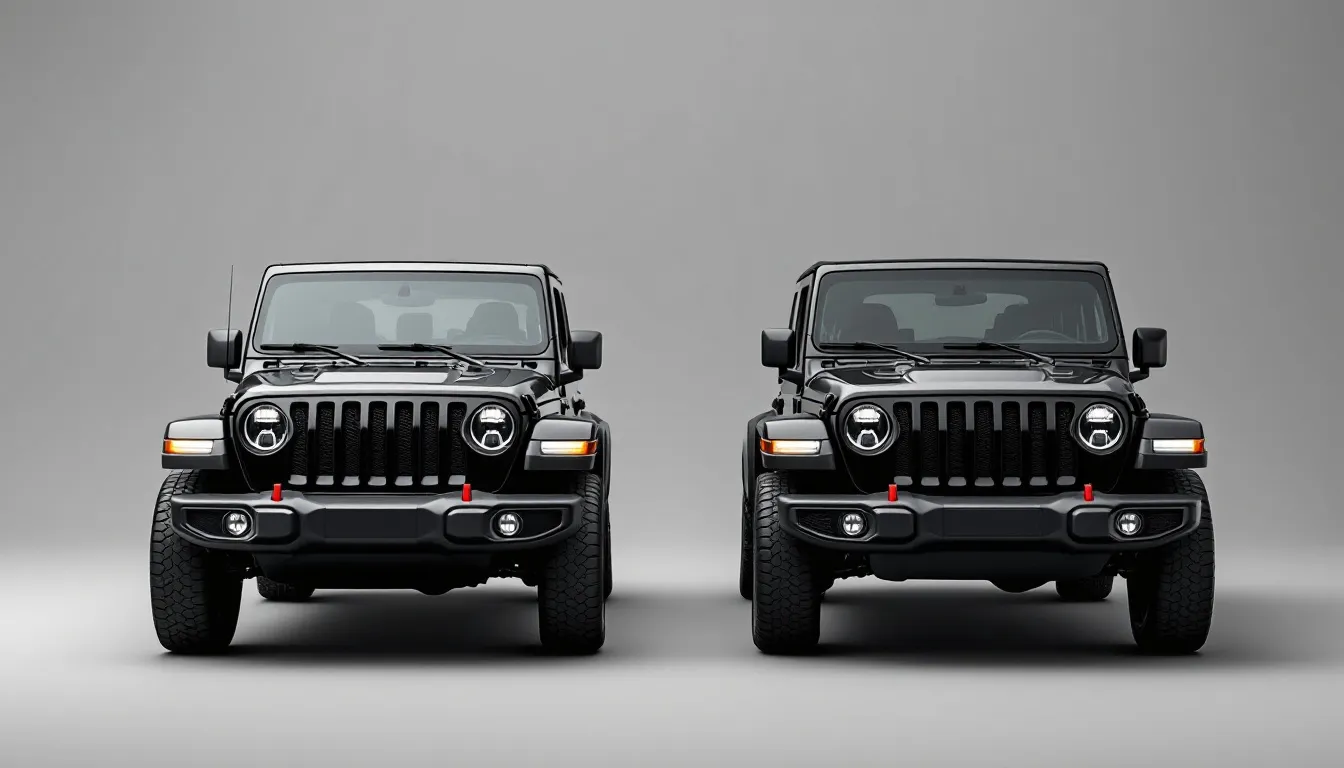
Jeep Wrangler JL vs JK: Key Differences Explained
The Jeep Wrangler JL is the current generation, produced from 2018 to the present. It replaced the JK, which ran from 2007 through 2018.
If you're researching the jeep wrangler JL vs JK question, here's what matters most: these are separate vehicle generations, not trim levels. Used-car shoppers confuse them constantly, and it matters enormously for parts compatibility, technology, and resale value.
The JK gave you a proven platform with a massive aftermarket and 11 years of refinement. The JL brought a stiffer frame, a quieter cabin, fuel-efficient powertrains, and modern infotainment the JK never offered. Which one makes sense depends on your budget, how you plan to use it, and whether factory tech matters more to you than parts availability.
This guide covers every meaningful difference: production years, exterior and interior changes, powertrains, off-road specs, aftermarket ecosystems, reliability patterns, and price. By the end, you'll know exactly which generation fits your situation.
Production Years and What Each Generation Covers
The JK ran from 2007 through 2018. The JL started with 2018 and remains in production today. That overlap creates real confusion when you're scanning listings.
Both a 2018 JK and a 2018 JL exist. They are not the same vehicle. The 2018 JK was the final model year of that generation; mechanicals and body stayed unchanged. The 2018 JL was the first model year of the redesign, with a new body, new frame, and updated powertrains.
When you see a 2018 listing, identify the generation explicitly. Many sellers don't flag it. Check the VIN, look at the headlights (round vs. trapezoidal is the fastest tell), or ask directly which generation it is.
Here's the clean breakdown:
- JK generation: 2007–2018 (2-door and 4-door Unlimited)
- JL generation: 2018–present (2-door and 4-door Unlimited)
The JL also introduced a pickup sibling, the Gladiator JT, in 2020. It shares the JL platform, which matters when shopping aftermarket parts; some JL-compatible accessories fit the Gladiator too, widening your options slightly.
How to Tell a JL from a JK on Sight
The fastest visual tell is the headlights. The JL uses round headlights in a trapezoidal housing. The JK uses round headlights set into a rectangular, boxy surround. The overall grille shape and front fascia differ noticeably.
Stand at the front of the vehicle. The JL's hood has a different profile, and the grille slots are narrower. Move to the side: the JL's doors and body panels have a cleaner, less squared-off appearance. The JL also introduced power-folding, frameless door mirrors on higher trims, something the JK never offered from the factory.
At the rear, the JL's taillights are more squared and sit differently in the tailgate. The fuel door location and spare tire carrier design also differ between generations.
Inside, the difference is immediate. A JK interior looks utilitarian, with older gauges and a small infotainment screen if equipped. A JL interior feels substantially more refined, with better materials, more storage, and a larger Uconnect screen.
On used-car listings, sellers sometimes skip the generation. Don't assume. If a listing shows 2018 or newer, confirm from the photos. Look at the headlight shape first. For comparing JL trims within the family, the JL Willys trim breakdown covers the sport-focused variant in detail.
Powertrain Options: What Each Generation Offers
The JK and JL offer completely different engine lineups. This is one of the most practically significant differences between generations.
JK powertrain options (2007-2018):
- 3.8L V6 (2007-2011): 202 hp, 237 lb-ft torque
- 3.6L Pentastar V6 (2012-2018): 285 hp, 260 lb-ft torque
The 2012 switch to the Pentastar was significant. Shopping a used JK? The 2012+ 3.6L models are generally preferred over the older 3.8L.
JL powertrain options (2018-present):
- 3.6L Pentastar V6: 285 hp in base form, available with eTorque mild-hybrid assist
- 2.0L turbocharged four-cylinder with eTorque: 270 hp, 295 lb-ft torque
- 3.6L V6 (non-eTorque): available on base trims without the mild-hybrid system
- 6.4L Hemi V8: available in the 392 variant
- Plug-in hybrid (4xe): combines a 2.0L turbo with two electric motors for 375 hp and roughly 21 miles of electric range
eTorque is a 48-volt mild-hybrid system that adds a belt-integrated starter-generator. It improves fuel economy and adds low-speed torque but is not a full EV system. The 4xe (pronounced "four-by-e") is Jeep's plug-in hybrid JL variant; it runs on electricity alone for short distances and qualifies for federal tax incentives depending on your situation.
For JL maintenance across all these powertrains, the JL maintenance schedule and service intervals guide covers oil change intervals, filter schedules, and the differences by engine type.
Interior Quality and Technology: Where the JL Pulls Ahead
The interior is where the JL separates itself most clearly from the JK. The JL cabin is quieter, better finished, and equipped with substantially more capable technology.
Owner reports consistently describe the JL as a significant step forward in NVH (noise, vibration, harshness) reduction. The JK, particularly in 2-door form with the standard soft top, is notoriously loud at highway speeds. The JL addressed this with improved door seals, a stiffer body, and better sound deadening.
Uconnect infotainment by generation:
- JK: Uconnect 4 appeared on later model years (2015 onward), typically with a 5-inch or 7-inch screen. No Apple CarPlay or Android Auto on any JK from the factory.
- JL: Uconnect 4 with a 7-inch screen is standard on Sport trim. Higher trims offer Uconnect 4C NAV with an 8.4-inch screen. Apple CarPlay and Android Auto are standard on all JL trims from 2018 onward.
That CarPlay/Android Auto difference is real in everyday use. JK owners frequently retrofit it after purchase, at added cost and complexity.
The JL also added features like a 7-inch digital cluster display (higher trims), improved HVAC controls, more rear-seat legroom in the JLU 4-door, and better door storage. If storage matters, check the JL door storage organizer options guide for practical upgrades.
The trade-off: more electronics mean more potential failure points. Early JL model years (2018-2019) saw Uconnect glitches and electrical gremlins per owner reports. That complexity is real, and it's worth factoring in if you're shopping a high-mileage early JL.
Off-Road Capability: JL vs JK on the Trail
Both generations are serious off-road vehicles, but the JL has measurable advantages from the factory. The JL's frame is stiffer and significantly lighter than the JK's. The suspension geometry was updated to improve articulation.
Ground clearance figures, per Jeep manufacturer specs (approximate, varies by trim and tire):
- JK Sport: approximately 8.8 inches
- JK Rubicon: approximately 10.0 inches
- JL Sport: approximately 9.7 inches
- JL Rubicon: approximately 10.8 inches
The JL Rubicon introduced a factory electronic front sway-bar disconnect, Dana 44 axles front and rear, and a 4:1 transfer case as standard. Owner reports generally rate the JL Rubicon as more capable than the JK Rubicon from the factory, particularly on technical rock terrain.
For owners wanting to push beyond stock JL capability, a lift kit is usually the first mod people add. The Rough Country 2.5" Lift Kit w/ N3 Shocks for Jeep Wrangler JL Unlimited is a popular entry-level option that fits up to 35-inch tires without major clearance issues.

On Amazon and eBay
Rough Country 2.5" Lift Kit w/ N3 Shocks for Jeep Wrangler
Check price on Amazon → See new and used on eBay →
See all current listingsPaid links. We may earn a commission from Amazon or eBay. Prices can change.
Protecting your undercarriage matters as much as lift height. The JL skid plate options worth buying guide covers what's worth adding over the factory steel. For tires, the all-terrain tire options for JL rock crawling guide breaks down the best options by terrain type and load rating.
Jeep Wrangler JL vs JK: Key Specs Compared at a Glance
Here's the side-by-side comparison most buyers need when sorting out the jeep wrangler JL vs JK question. Figures are approximate and based on manufacturer specs where available; real-world results vary by trim, tire, and configuration.
| Spec | JK (2007-2018) | JL (2018-present) |
|---|---|---|
| Production years | 2007-2018 | 2018-present |
| Engine options | 3.8L V6; 3.6L Pentastar V6 | 3.6L V6; 2.0L turbo; 6.4L V8 (392); 4xe PHEV |
| Infotainment system | Uconnect 4 (2015+, up to 7") | Uconnect 4 / 4C NAV (7" or 8.4") |
| Ground clearance, Sport (approx.) | ~8.8 in | ~9.7 in |
| Ground clearance, Rubicon (approx.) | ~10.0 in | ~10.8 in |
| Factory CarPlay/Android Auto | No | Yes (all trims) |
| Sway-bar disconnect, Rubicon | Electronic | Electronic (refined) |
| Body styles | 2-door; 4-door Unlimited | 2-door; 4-door Unlimited |
| Approximate GVWR (4-door, approx.) | ~5,000 lb | ~5,500 lb |
What the table doesn't capture: the JL's improved structural stiffness, the substantially reduced highway noise reported by owners who've driven both, and the JL's wider range of powertrain choices including the 4xe. Those differences matter in daily driving even if they don't show up in a spec sheet.
Does the Jeep Wrangler JL vs JK Aftermarket Difference Actually Matter?
The JK has a larger, more mature aftermarket than the JL, but the JL ecosystem has grown quickly. If you're upgrading from a JK to a JL, assume zero part crossover.
The JK ran for 11 years. That's 11 years of aftermarket development. Bumpers, lift kits, armor, lights, tops, doors: virtually every category has dozens of options from established brands, and pricing reflects the volume. Discontinued parts are often still available used, because so many JKs were sold.
The JL aftermarket is now well-established but not as deep in every category. The upside: JL-specific parts are designed for the new frame and body dimensions from the start, so fitment is generally cleaner than adapted JK parts.
Here's the critical point for JK owners: JK and JL bumpers, fenders, sliders, and body armor don't interchange. Frame dimensions, mounting points, and body lines differ between generations. If you're switching from a JK to a JL, budget for replacing all your aftermarket hardware.
For bumpers, the JL market has solid options across price ranges. The ECOTRIC Front Bumper Compatible with Jeep Wrangler JK JL/JLU Gladiator JT is a lower-cost entry option that fits both JK and JL:

For rear protection on a JL build, the CLAMBER Off-Road Rear Bumper for Jeep Wrangler JL/JLU provides solid impact protection:

If you want a stubby front bumper that fits both generations and the Gladiator, the Tyger Auto TYGER FURY Stubby Front Bumper w/Winch Plate works across JK, JL, and JT fitments:

Reliability and Model Years to Watch in Each Generation
Neither generation is perfect. Both have known problem areas. Knowing which years to approach carefully saves money when shopping used.
JK reliability notes:
2007-2011 models with the 3.8L V6 are generally considered the weaker option. Owner reports cite cooling issues and lower power output compared to the later Pentastar. 2012 and newer JKs with the 3.6L Pentastar are broadly regarded as more reliable. Owner forums flag water pump failures and cam phaser noise on higher-mileage 3.6L examples.
Death wobble (severe steering oscillation at highway speeds) is well-documented on JKs, typically linked to worn track bar, tie rod, or control arm components. It's not universal but worth inspecting before purchase.
JL reliability notes:
Early 2018-2019 JLs saw Uconnect software bugs and electrical issues per owner reports. Most were addressed via software updates or dealer service. The 2.0L eTorque four-cylinder has fewer long-term owner data points than the 3.6L, simply because it hasn't been in service as long.
The 4xe has its own set of reported quirks, mainly around PHEV system behavior in extreme cold. This is an area where forum research before purchase matters. Later JL model years (2021 onward) generally have fewer early-build gremlins, as the platform matured.
For service interval planning on any JL variant, the JL service intervals and maintenance schedule guide covers what to expect by mileage and powertrain.
Price and Value: What Each Generation Costs Today
Used JK prices have settled into a predictable range. JL values remain higher due to the newer platform and ongoing production.
As a rough guide (prices are market-dependent and approximate):
- Used JK (2012-2018, clean condition): Expect $15,000 to $30,000 depending on trim, mileage, and modifications. Rubicons command a premium at any mileage.
- Used JL (2018-2022): Generally $28,000 to $45,000+ for clean examples with reasonable mileage. 4xe models tend to hold value well.
- New JL (2026 model year): Sticker prices start around $35,000 for a Sport and climb well past $60,000 for a loaded Rubicon 392.
The JK is a legitimate choice if you're budget-conscious or if you want maximum aftermarket depth for a trail build. You get more vehicle per dollar on a used JK, and the parts ecosystem is deep.
The JL costs more at every price point, but you're getting factory tech the JK never offered, a stiffer and safer structure, and powertrain options that include a plug-in hybrid.
JL or JK: Which Wrangler Should You Buy?
For most buyers in 2026, the JL is the stronger choice. The JK is not obsolete. Those are the two core facts.
Three factors should drive your decision: budget, technology needs, and parts planning. If you need factory CarPlay, a quieter highway ride, or access to eTorque and 4xe powertrains, the JL is the only option. If you need maximum value per dollar or you're building a trail rig with an eye on parts availability, a clean JK with the 3.6L Pentastar still makes practical sense.
For anyone moving from a JK to a JL: your parts budget assumptions need to change. Nothing crosses over.
If you're planning a JL build, start with the fundamentals. Check out the JL skid plate guide for your first trail build and all-terrain tire picks for the JL before you spend anything on the fun parts. When you're ready to map out the full build, the Hooke Road Different Trail X Front Bumper for 2018-2026 Jeep Wrangler JL & Gladiator JT is a capable steel option purpose-built for modern JL builds:

If you're comparing JL trims specifically, the JL Willys trim review covers how the Willys stacks up against Sport and Rubicon specs.
Frequently Asked Questions
What distinguishes a JL model Jeep Wrangler from other generations?
The Jeep Wrangler JL is the 2018-and-newer generation, identified by round headlights in a trapezoidal housing, standard Apple CarPlay and Android Auto, a stiffer frame, and access to powertrains including the 2.0L turbo with eTorque and the 4xe plug-in hybrid. It's a fully redesigned vehicle compared to the JK, not a refresh.
How can you identify whether a Jeep Wrangler is a JK model?
A JK Wrangler was produced from 2007 through 2018. The easiest visual identifier is the older-style boxy front fascia and rectangular headlight surround. Inside, JK Wranglers lack factory Apple CarPlay and Android Auto. On a 2018 listing, always confirm the generation explicitly, since both a 2018 JK and a 2018 JL were sold.
Which model years should be avoided when shopping for a JK Wrangler?
Owner reports and forum consensus generally flag 2007 through 2011 JK models as weaker years, due to the older 3.8L V6 engine. The 2012 model year onward, with the 3.6L Pentastar, is typically preferred. Death wobble and cam phaser noise on high-mileage examples are worth inspecting across all JK years.
How do reliability ratings compare between JL and JK Wranglers?
Both generations have known issues. JK reliability is well-documented over 11 years of ownership. The JL has fewer years of data but owner reports suggest early 2018-2019 models had some Uconnect software and electrical issues that later years improved upon. The JL's added electronic complexity, especially on 4xe, introduces more potential failure points than the simpler JK.
What are the key differences between JL, JK, and TJ Wranglers?
The TJ ran from 1997 through 2006, the generation before the JK. It used round headlights that the JL brought back, but similarities end there. The TJ used a solid front axle with coil springs (an upgrade from earlier leaf springs), while the JK and JL both use solid front axles with coil springs plus much more modern electronics. The JL is the newest; TJ and JK are progressively older.
Should buyers choose a JL or JK model?
It depends on budget and priorities. The JL offers more technology, a quieter ride, and newer powertrains at a higher price. The JK offers more used-vehicle value, a larger parts ecosystem, and simpler electronics. If modern tech and fuel economy matter, choose the JL. If budget is the main driver or you're building a dedicated trail rig, a clean JK is a solid choice.
What distinguishes the Rubicon trim between JL and JK generations?
Both Rubicon trims include Dana 44 axles, a 4:1 low-range transfer case, and an electronic sway-bar disconnect. The JL Rubicon adds approximately 0.8 inches more ground clearance over the JK Rubicon per manufacturer specs, refined electronic integration, and the option for the 4xe powertrain. The JL Rubicon 392 introduced a factory 6.4L Hemi V8 option that was never available in any JK Rubicon.
The Bottom Line
The JL is the better vehicle for most buyers today, but the JK is not obsolete. Keep those two facts in mind.
Budget, technology needs, and parts planning should drive your decision. If you need factory CarPlay, a quieter highway ride, or access to eTorque and 4xe powertrains, the JL is your only option. If you need maximum value per dollar or you're building a trail rig, a clean JK with the 3.6L Pentastar still makes practical sense.
If you're planning a JL build, start with the fundamentals. Check the JL skid plate guide and all-terrain tire picks before spending on the fun parts. When you're ready to map out your full build, start planning with the JL Build Planner to see how the mods stack up together.