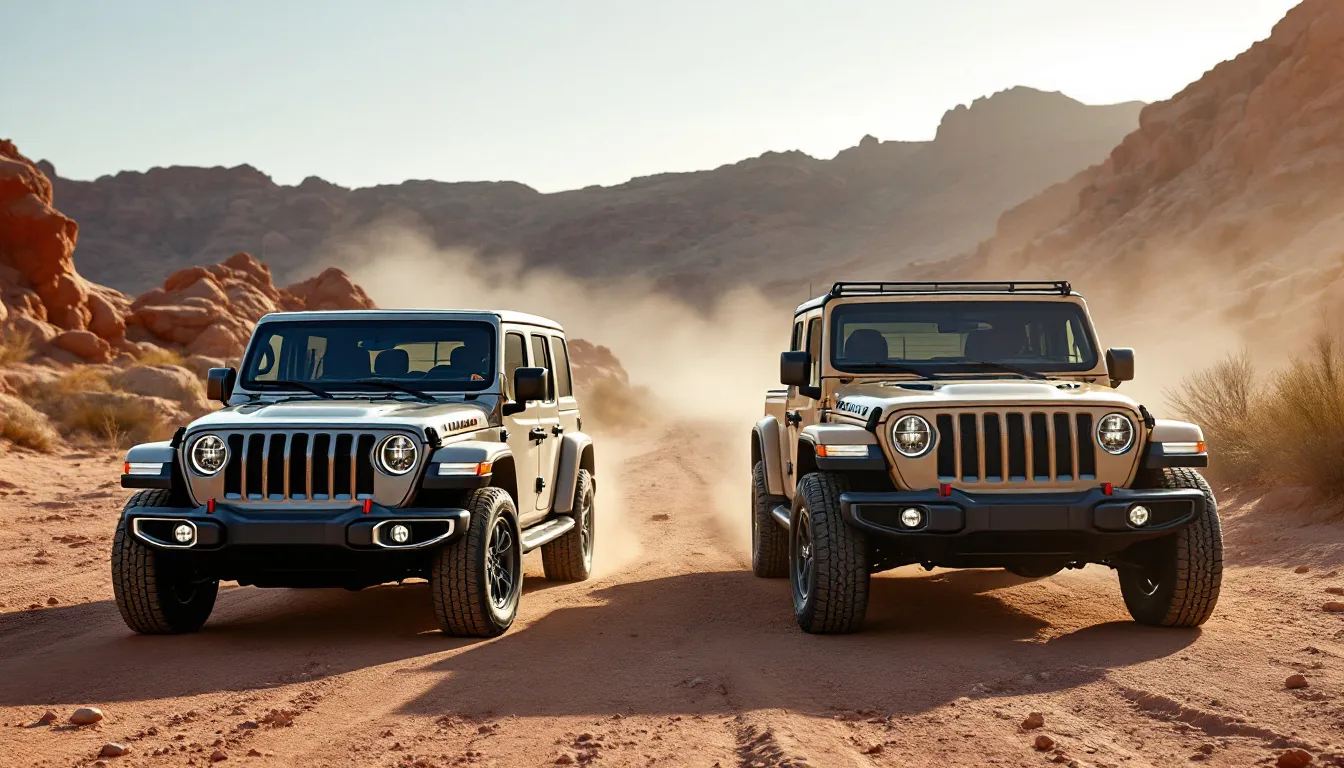
The Jeep Gladiator is a mid-size pickup built on the Wrangler JL platform. It adds a five-foot cargo bed and a longer wheelbase while keeping the JL's open-air capability and solid axles intact. If you're comparing the Wrangler JL vs Gladiator, here's the direct answer: buy the Gladiator if you regularly haul or tow. Buy the Wrangler JL if you prioritize trail agility, a lower price, or a smaller daily footprint.
Both share the same 3.6L Pentastar V6 and available 3.0L diesel, the same Uconnect infotainment system, and identical front-end architecture. Everything that matters after that flows from one key difference: bed versus no bed, longer wheelbase versus shorter, and a price gap of roughly $3,000 to $5,000 at equivalent trims.
Before you commit to either, check the Jeep Wrangler JL buyer's guide for a full breakdown of trim levels, available packages, and year-by-year changes. That context makes the comparison below much more useful.
Shared Platform: What the Wrangler JL and Gladiator Have in Common
The Wrangler JL and Gladiator share the same core architecture: identical front solid axle, same engine lineup, same eight-speed automatic or six-speed manual transmission, and the same basic Uconnect interface. That shared DNA is your starting point for understanding why comparing them actually works.
Here's the important distinction: the Gladiator isn't a separate design that happens to look like a Wrangler. It's a stretched JL with a cargo bed bolted where the rear cargo area and tailgate would be. Both vehicles use the same front half of the body, the same doors on four-door configurations, and the same removable top system.
This overlap matters significantly if you're planning a build. Front bumpers, LED headlights, hood accessories, and many suspension lift kits share fitment between the two. The aftermarket developed for the JL largely carried over to the Gladiator at launch, which means builders on either platform benefit from years of JL-specific product development.
Where they diverge structurally: the Gladiator adds a longer frame, swaps rear coils for leaf springs, and runs a Dana 44 rear axle as standard (versus the JL's Dana 35 on base trims). That longer wheelbase also changes approach and departure geometry, which matters when you're navigating tight trails.
If you're researching how today's platform compares to the previous generation, the guide on how the JL differs from the older JK covers the suspension, tech, and structural changes that define the current generation.
Jeep Wrangler JL vs Gladiator: Key Specs Side by Side
The fastest way to see what separates these two is a direct spec comparison. Here's how the four-door JLU lines up against the Gladiator JT across the dimensions that matter most.
| Specification | Wrangler JLU | Gladiator JT |
|---|---|---|
| Wheelbase | 118.4 in | 137.3 in |
| Overall Length | 188.4 in | 218.0 in |
| Curb Weight | ~4,439 lb | ~4,650 lb |
| Max Towing | 3,500 lb | 7,650 lb |
| Max Payload | 1,000 lb | 1,700 lb |
| Ground Clearance (Rubicon) | 10.8 in | 11.1 in |
| Bed Length | N/A | 60.0 in (5 ft) |
| Base MSRP Range (approx.) | $33,000–$36,000 | $37,000–$40,000 |
Specs reflect published figures for the 3.6L V6 configuration. Verify current pricing at Jeep's official site, as MSRP changes by model year and region.
The plywood test: A standard 4x8 sheet of plywood does not fit flat inside the Gladiator's bed with the tailgate closed. At 60 inches, the bed falls 8 inches short of a full sheet. You can haul one with the tailgate dropped and a bed flag, but expect overhang. If sheet goods are a regular cargo need, the Gladiator handles it with the tailgate down.
The wheelbase gap of nearly 19 inches is the number to focus on. That's what gives the Gladiator its towing advantage and what costs it in tight switchbacks.
Towing Capacity and Hauling: Where the Gladiator Wins Clearly
On towing capacity, the Gladiator wins by a substantial margin. The Wrangler JLU is rated at 3,500 lb; the Gladiator is rated at 7,650 lb with the 3.6L V6. That's more than double the capacity.
That gap exists because the Gladiator has a purpose-built truck frame with a conventional hitch receiver, a longer wheelbase for stability under load, and rear leaf springs engineered to carry weight. The Wrangler's rear coil setup was never designed for serious towing work. You can tow a small trailer or light boat with a JLU, but the Gladiator is the right tool for anything over 3,000 lb.
One common mistake: assuming the Gladiator competes with full-size pickups like the F-150 or Ram 1500. It doesn't. At 7,650 lb rated towing, it's a capable mid-size hauler, but full-size trucks push 10,000-plus lb. The Gladiator fills the gap between a stock Wrangler and a full-size workhorse.
If you're planning to tow with either vehicle, a proper 4-pin trailer wiring harness is a practical first purchase. Both the JL and Gladiator use the same harness connection point, so one product fits both platforms.

For a more budget-friendly option that covers the same 2018-2025 Wrangler and 2020-2025 Gladiator fitment, this 4-pin trailer harness runs considerably less:

Payload follows the same pattern: 1,700 lb in the Gladiator's bed versus roughly 1,000 lb in the JLU's cargo area. If you carry tools, equipment, or gear that adds up, the Gladiator's numbers give you real working headroom.
Wrangler JL vs Gladiator Off-Road: Rubicon Compared
Both vehicles are genuinely capable off-road. The Wrangler JL holds a meaningful edge on tighter, technical trails because of its shorter wheelbase, and you'll feel it in breakover angle.
The Wrangler JLU Rubicon has a breakover angle of 22.6 degrees. The Gladiator Rubicon's is 20.3 degrees, a measurable difference that matters on sharp hill crests and rock ledges. The Gladiator's 137.3-inch wheelbase also makes it more likely to high-center on tight switchbacks and V-shaped terrain features that a shorter JLU clears without drama.
Owner reports from popular trail systems consistently note that the Gladiator requires more line planning on technical single-track terrain. On open desert, dunes, and moderate trails, the difference is minimal.
Gladiator Rubicon vs Gladiator Mojave: These are two distinct missions. The Gladiator Rubicon is the rock crawler: front and rear Dana 44 axles, electronic front sway bar disconnect, locking differentials front and rear, 33-inch mud-terrain tires, and 11.1 inches of ground clearance. The Gladiator Mojave is built for high-speed desert running, with Fox Racing shocks, a hydraulic jounce bumper, and stiffer desert-tuned suspension. It trades the Rubicon's locking diffs for desert composure. Want to run Moab? Buy the Rubicon. Running Baja terrain? The Mojave makes more sense.
At the Rubicon trim level, both JL and Gladiator get identical front axle hardware and the same transfer case. The off-road hardware advantage of the Rubicon badge applies equally to both vehicles, which means the Wrangler Rubicon's shorter wheelbase is a genuine trail advantage, not a compromise.
For underbody protection on either platform, the guide to skid plates for JL and Gladiator covers compatible options. If you're choosing tires for either build, all-terrain tire options for the JL platform apply to the Gladiator's front end as well.
Does the Gladiator Ride Better Than the Wrangler?
The Gladiator rides slightly more settled than the Wrangler JLU when loaded. When empty, it's a different story. This nuance gets oversimplified in most comparisons.
The Gladiator uses rear leaf springs instead of the Wrangler's rear coil springs. Leaf springs are stiffer by design and better suited for carrying payload. When the bed is loaded, that stiffness works in your favor and the truck tracks predictably. When the bed is empty, which is most of the time for many owners, the rear suspension feels noticeably firm. The truck hops and jiggles over road imperfections more than an unladen JLU.
The Wrangler's rear coils, by contrast, are tuned for an unladen vehicle. Day-to-day highway driving feels more composed in a stock JLU because the suspension is calibrated for occupant comfort rather than payload capacity.
At highway speeds, both vehicles share the same fundamental limitation: solid front and rear axles, short suspension travel compared to independent setups, and tall, relatively narrow bodies. Neither is a smooth freeway cruiser. Owner reports generally agree that above 65 mph, the Gladiator and Wrangler feel similarly bouncy.
If suspension performance on long highway drives is a deciding factor, neither vehicle will surprise you in a positive way. Both are built for a different mission. Regular maintenance keeps both running as designed; see the JL maintenance schedule for service intervals that apply broadly across both platforms.
Price Difference: What You Pay for the Truck Bed
The Gladiator carries a premium of roughly $3,000 to $5,000 over a comparably equipped Wrangler JLU at most trim levels. That premium is essentially the price of the bed, the longer frame, and the towing capability.
Here's an approximate MSRP range by trim as of 2026 (verify current figures at Jeep's site, as prices shift by model year and region):
| Trim | Wrangler JLU | Gladiator JT |
|---|---|---|
| Sport / Sport S | ~$33,000–$36,000 | ~$37,000–$40,000 |
| Willys | ~$40,000–$43,000 | ~$43,000–$46,000 |
| Sahara | ~$44,000–$48,000 | ~$47,000–$51,000 |
| Rubicon | ~$51,000–$56,000 | ~$54,000–$59,000 |
The Gladiator Sport and Jeep Gladiator Sport S trim levels are entry points for buyers who want the pickup body without the full off-road hardware of the Rubicon. They're worth considering if towing and payload are your primary motivation and you don't need locking diffs.
One framing that helps: if you need a truck for work or recreation hauling, the premium over a Wrangler JLU is easy to justify. If you want a Jeep for trails and open-air driving and you're telling yourself "I might need the bed sometimes," that occasional use rarely justifies the price gap, the parking penalty, or the trail limitations.
The full JL trim breakdown and pricing guide covers JLU trim details in depth. If you're considering the Willys edition as a value option, the Willys edition value analysis breaks down whether that trim's off-road content is worth the step up from Sport.
Mods and Builds: How Much Do Parts Overlap?
Front-end modifications are largely interchangeable between the Wrangler JL and Gladiator. Rear-end accessories are platform-specific. That's the practical rule for planning a build across either vehicle.
The shared front architecture means front bumpers, winch plates, LED headlights, hood hinges, and many lift kit components, particularly front control arms and track bars, are designed to fit both JL and Gladiator without modification. This matters significantly: the JL-specific aftermarket, which has had years to mature, is largely available to Gladiator owners too.
Here's a front bumper that explicitly lists both JL and Gladiator JT fitment:

A stubby bumper option that covers both platforms, along with JK compatibility for builders who've crossed generations:

LED headlights are another direct carry-over. These 9-inch round LED headlights fit both the JL and Gladiator JT:

Where compatibility breaks: rear suspension components, rear bumpers, and all bed accessories (bed racks, tonneau covers, bed liners) are Gladiator-specific. The JL and Gladiator use completely different rear suspension designs, so rear lift components do not cross over.
If you're planning a build on either platform, the structural differences between JL and JK generations are worth understanding first. The guide on JL vs JK platform differences for mod planning explains what changed and why it matters for parts selection.
Reliability: Which One Has the Better Track Record?
The Wrangler JL has a longer production history, which means more owner data, more documented TSBs, and a better-understood failure pattern. The Gladiator, launched for 2020, has a shorter track record.
Both share the same powertrain, so known JL engine and transmission issues apply equally to the Gladiator. The 3.6L Pentastar V6 has a documented history of oil consumption on high-mileage examples. The eight-speed automatic had early software-related shift quality concerns that Jeep addressed through updates.
The Gladiator adds a few platform-specific concerns that owners report. The longer body can amplify flex on uneven terrain. Some owners have noted squeaks and rattles developing earlier than expected around the bed area and the extended frame. None of these are catastrophic, but they're worth knowing.
Where the data is thin: long-term Gladiator reliability at 150,000-plus miles is genuinely underreported because the vehicle hasn't been in production long enough for a large sample of high-mileage examples. Honest answer: we don't yet know how the Gladiator-specific frame and rear suspension components hold up over time in the same way we understand the JL's powertrain.
Staying on top of service intervals matters on both vehicles. The JL service intervals and maintenance schedule applies directly to Gladiator powertrain service as well.
Which Wrangler JL vs Gladiator Option Is Right for You?
The decision comes down to one question: do you need a truck bed and real towing capacity? If yes, the Gladiator is the right vehicle. If no, the Wrangler JLU gives you the same DNA at a lower price with better trail agility.
Choose the Wrangler JLU if:
- Trail agility and tight technical terrain are priorities
- You won't regularly tow over 3,500 lb
- Daily driving in urban or suburban environments matters
- A lower price point and lower trim entry cost matter
- You want the widest possible mod selection with the longest aftermarket history
- Parking in tight spaces or shorter vehicle length is a practical concern
Choose the Gladiator if:
- You regularly haul tools, equipment, or gear in a bed
- Towing a trailer, boat, or camper is a real and frequent need
- You want the open-air Jeep experience with actual truck utility
- The Gladiator Sport trim's price premium over a JLU is acceptable
- High-speed desert running appeals to you (Mojave trim)
- You want the Rubicon's off-road hardware with payload capacity
Neither choice is wrong. They're genuinely different tools that share a foundation. A Gladiator owner who rarely uses the bed has paid extra for capability they don't use. A Wrangler owner who regularly rents a trailer has made a different compromise.
If you've landed on the Wrangler JL, you can plan your JL build with the JL Build Planner to map out trims, modifications, and costs before you buy.
See the full JL trim and options guide to get into the specifics of which Wrangler JL trim makes sense before you configure.
Frequently Asked Questions
These questions come directly from what JL and Gladiator shoppers search for most often. Answers are kept concise for quick reference.
Will a standard sheet of plywood fit in the bed of a Gladiator?
No, not with the tailgate closed. The Gladiator's bed is 60 inches (5 feet) long, and a standard 4x8 sheet of plywood is 96 inches. You can carry one with the tailgate dropped and a bed flag, but it will overhang by about 36 inches. For regular sheet goods hauling, a full-size pickup with a 6.5-foot or longer bed is more practical.
Does the Gladiator provide a smoother ride than the Wrangler?
It depends on load. When the bed is loaded, the Gladiator's rear leaf springs track more predictably. When the bed is empty, which is most of the time, the leaf springs feel noticeably stiffer than the Wrangler's rear coils, and owners commonly report more harshness over rough pavement. On unladen highway driving, many owners find the JLU rides marginally more comfortably.
What are the towing capacities of each model?
The Wrangler JLU is rated at 3,500 lb maximum towing with the 3.6L V6. The Gladiator JT is rated at 7,650 lb with the same engine. That gap exists because the Gladiator has a truck-rated frame, rear leaf springs, and a proper receiver hitch. The Wrangler can tow light trailers and small boats, but it is not a towing vehicle.
How do the wheelbase measurements differ?
The Wrangler JLU has a 118.4-inch wheelbase. The Gladiator JT has a 137.3-inch wheelbase, a difference of nearly 19 inches. That longer wheelbase is what enables the Gladiator's truck bed and towing stability, but it reduces trail agility, particularly on tight switchbacks and technical terrain where a shorter vehicle has a clear advantage.
What distinguishes the Gladiator Rubicon from the Gladiator Mojave?
The Gladiator Rubicon is built for technical rock crawling: front and rear locking differentials, electronic front sway bar disconnect, Dana 44 axles front and rear, and 33-inch mud-terrain tires. The Gladiator Mojave is tuned for high-speed desert running, with Fox Racing shocks, a hydraulic jounce bumper front and rear, and stiffer desert suspension. The Mojave does not include the locking differentials standard on the Rubicon.
Are Wrangler JL and Gladiator mods interchangeable?
Front-end mods largely are: bumpers, LED headlights, winch plates, and many lift components share fitment. Rear-end mods are platform-specific because the Gladiator uses rear leaf springs and a truck frame while the JL uses rear coil springs. Bed accessories (racks, liners, tonneau covers) are Gladiator-only by definition. For interior organization, JL interior storage options also fit the Gladiator's cab, which is structurally the same as the JLU's.
The Bottom Line
The Wrangler JL and Gladiator JT share so much DNA that the decision rarely comes down to capability. Both are capable off-road. Both offer open-air driving. Both are built on a platform the aftermarket supports well. The real decision is whether you need a bed and 7,650 lb of towing capacity enough to justify roughly $4,000 more at the window and a 19-inch longer wheelbase in daily life.
If the bed wins your budget, buy the Gladiator. If it doesn't, the Wrangler JLU gives you more trail agility, a lower price, and the same core experience. For readers who've decided on the JL, plan your JL build using the JL Build Planner, and start with the JL trim and options breakdown to find the right starting point.